

The illustration of threshold and generation with feminine imagery is humanity’s oldest continuous symbolic legacy.

From Paleolithic cave art to the architectural marvels of the Neolithic and modern religious iconography, depictions of eggs, pubic triangles, vulvas, bellies, maternal bodies, and blood have remained at the forefront of the human imagination.
Yet modern readers have often framed these images as early pornography or simple fertility charms:
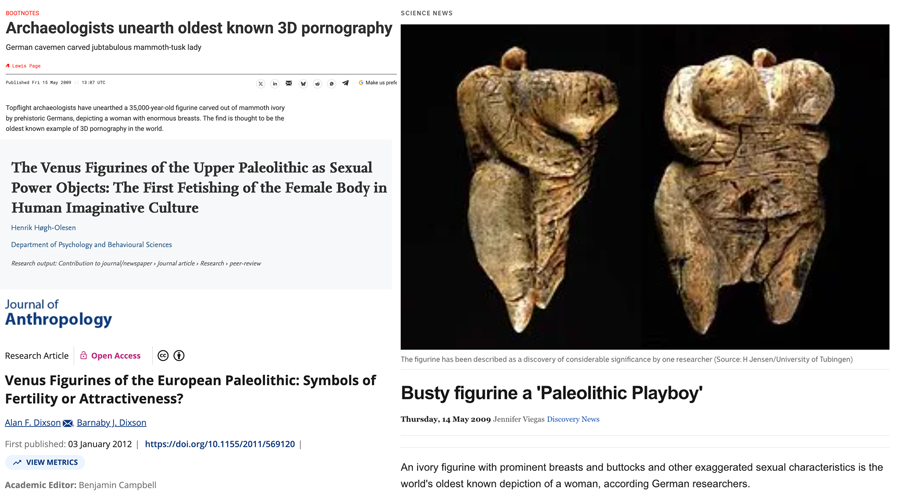
Fertility explains why the body might stand for the beginning of life. But what happens when the same imagery turns up in places associated with the dead?
The Neanderthal World
c. 400,000–40,000 years ago
Long before Venus figures, Neanderthal cave ritualism defined the underlying symbolic grammar from which later sacred imagery and custom would draw their power. Their use of red ochre, a pigment resembling blood, and emphasis on the cave, bear, skull and femur, and burial set the stage for the various religious traditions born across the northern hemisphere since.
At La Ferrassie in southwestern France, the relationship between marked stone and the dead takes a particularly suggestive form. A limestone slab bearing eighteen cupules—small, deliberately hollowed depressions—was discovered over the Neanderthal child known as La Ferrassie 6, with its marked surface facing downward toward the body. The carvings occupied the burial space, bringing the stone into an intimate relationship with the deceased.
The slab contains a fissure that has attracted comparison with the vulva. Rock-art researcher Robert Bednarik considers this reading alongside the occurrence of cupules within vulval triangles, including a later Aurignacian example from La Ferrassie. The significant possibility is that an image associated with generation accompanied a child into death, placing the source of life within the setting of burial.
This is the foundation of the goddess-centered philosophy explored in later eras. The feminine symbolism of the cave, earth, and cupules gives religious form to a relationship between death and rebirth. The maternal body provides the model for an earth that receives its dead and restores life, allowing ancestral reincarnation to be imagined through the familiar mystery of birth.
Upper Paleolithic
c. 45,000–12,000 years ago
With the Upper Paleolithic, the same relationship between enclosure, generation, and the dead begins to take an explicit form. Some are a simple triangular outline with a central incision; others belong to carefully worked figures in which the breasts, abdomen, or genitalia are emphasized.
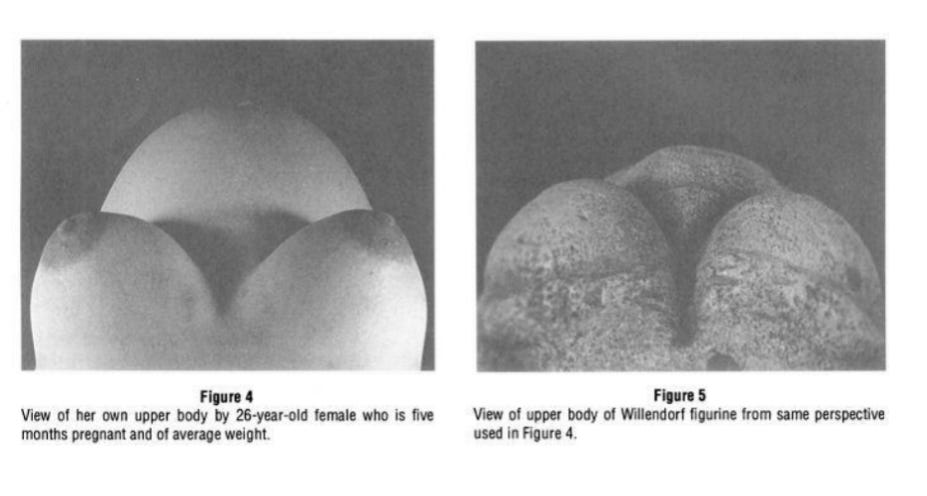
One compelling reading suggests that many of the famous Venus figures may represent what a woman can actually see of her own body when looking down—the foreshortened torso, the prominent breasts and belly—rather than an idealized or eroticized form created for men.
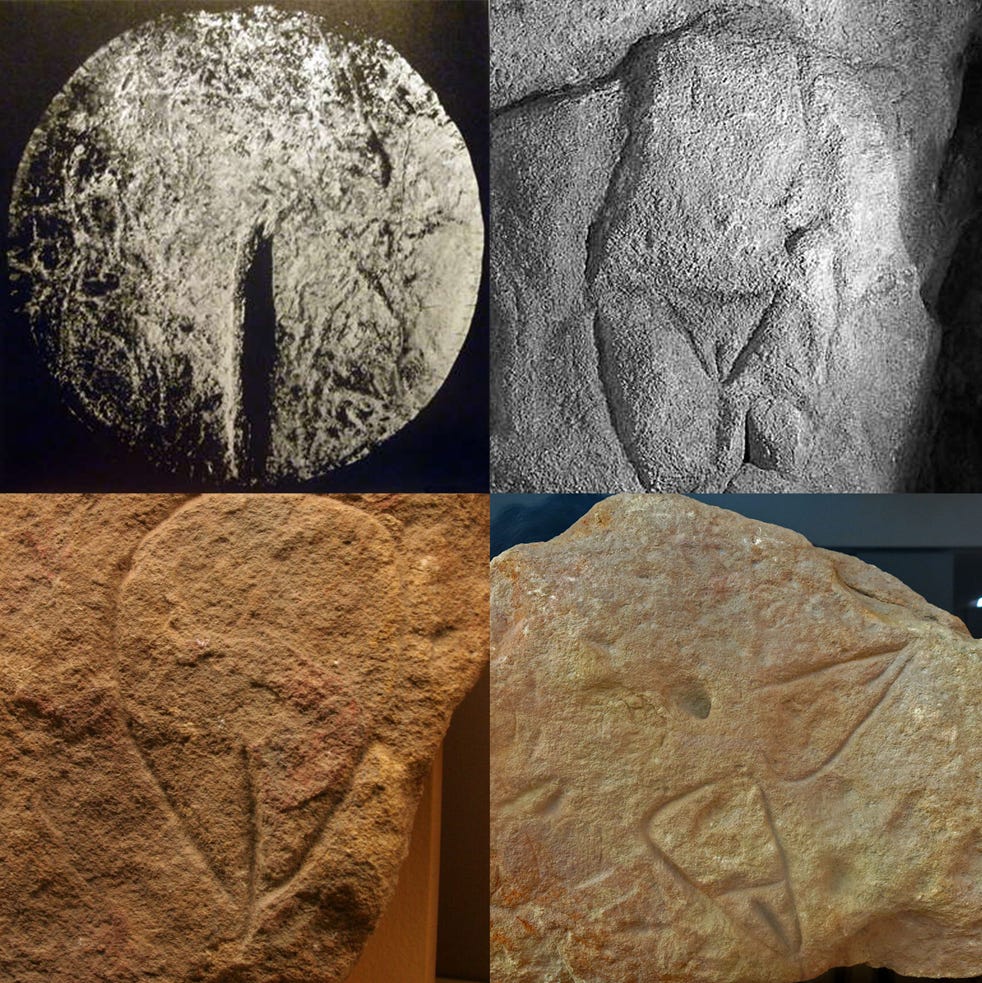
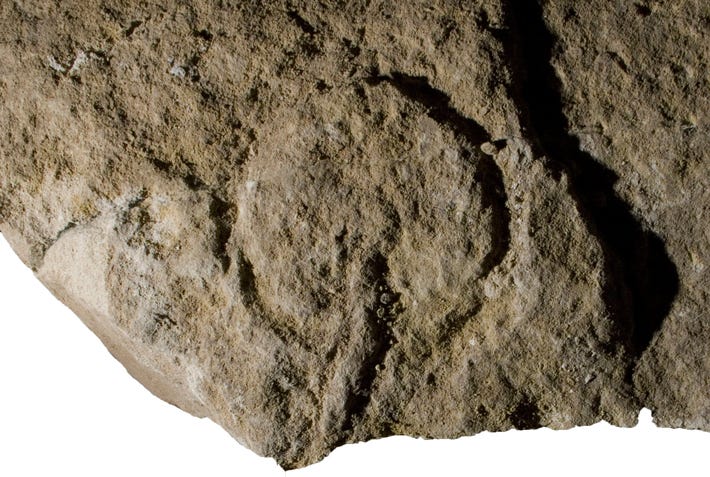
At Abri Castanet, a rock shelter in France’s Dordogne region, vulvas were engraved into the limestone ceiling around 37,000 years ago. Part of that ceiling later collapsed onto the ground, preserving the decorated surface. These images occupied the shelter overhead, placing representations of the female body within the community’s everyday surroundings. At neighboring Abri Blanchard, further engravings—including two vulvas on a single block—suggest that this imagery belonged to a wider tradition.
At Chauvet, vulval imagery extends into the deepest parts of the cave, where a descending rock formation bears a female lower body and pubic triangle. Reaching them required a journey into the earth. Their placement gives the maternal reading of the cave a physical dimension—the visitor enters an enclosing darkness and encounters the image of the space through which life emerges.
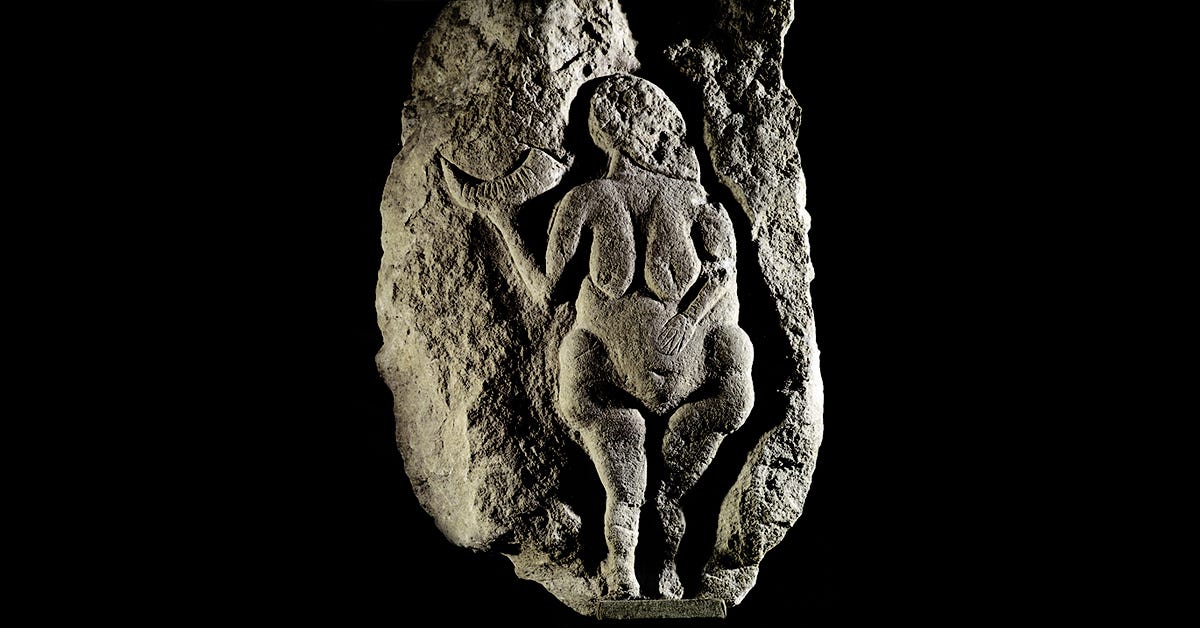
The Venus of Laussel, carved in relief on limestone in the Dordogne around 25,000 years ago, rests one hand on her abdomen, as if pointing to her womb, while raising a curved animal horn in the other. The horn, generally identified as that of a bison, has also been interpreted through its resemblance to a crescent moon. Thirteen vertical incisions mark its surface, perhaps representing the thirteen lunations of the solar year or the lunar rhythm of ovulation. The relief still bears traces of red ochre that would once have caught the changing light at the mouth of the shelter.
These signifiers alone provide symbolism beyond a general wish for fertility, demonstrating an understanding of generation as something embedded in time, belonging to a world of recurring seasons and bodily changes.
Practical knowledge and religious meaning coexist here: the woman points to the place where life begins while holding aloft an image that situates that beginning in the wider rhythms of the living world.
As we move toward the Mesolithic, more enduring dwellings bring the relationship between the body and sacred space into a domestic setting. Here, we approach a more familiar religious world, where the powers of generation and renewal are encountered within the routines of the home.
The Home and the Hearth
Mesolithic–Neolithic
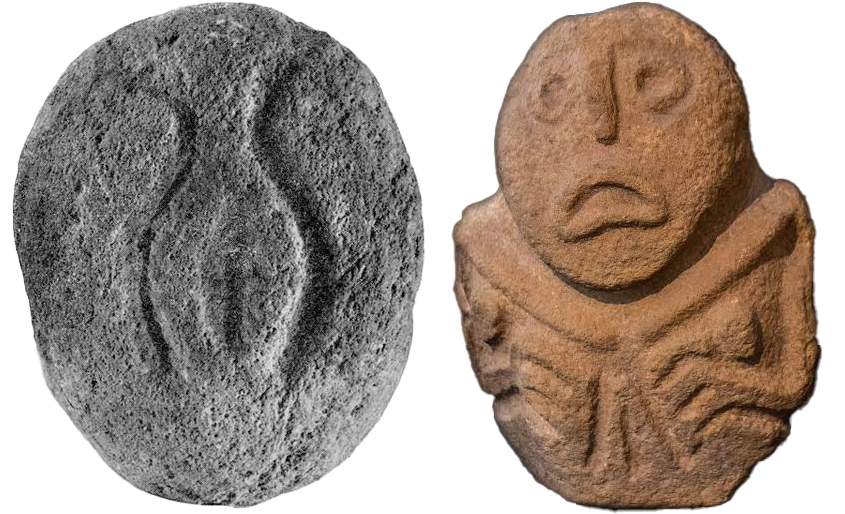
At Lepenski Vir, on the Danube in present-day Serbia, distinctive trapezoidal buildings contain rectangular, stone-lined hearths, with sculpted boulders positioned around them. Among these was a stone conventionally named “Vulva,” found in front of the hearth in House 51. Its placement brings an image of female anatomy beside the fire that warmed the dwelling and sustained its inhabitants. The relationship between bodily imagery and enclosing space that we considered in the caves can now be explored within a deliberately constructed home.
Human remains were buried within and around the buildings, while some sculptures stood above burials or behind hearths. These arrangements varied across the settlement’s history, but repeatedly brought dwelling, fire, imagery, and the dead into proximity. Read alongside the maternal symbolism we have been tracing, the house becomes an enclosure that both sustains life and receives it at its end. The dead remain connected to the community, tying the home to cycles of renewal.
At the Neolithic settlement of Achilleion in Thessaly, Greece, pregnant figurines were found in the courtyard areas where grain was ground, and bread was baked. A miniature oven from the Tisza culture in Hungary bears a navel on its rounded body. Later hearth goddesses such as Hestia and Vesta, and the Evenki ancestral figure who protects the fireplace and the family’s shelter, continue to link the maternal presence that maintains the warming fire and the memory of the generations that have lived in its glow.
The Uterine Architecture of Newgrange
c. 3200 BC
In the passage tombs of the Neolithic, the concept of reincarnation acquires a fully manmade architectural expression. Newgrange specifically encapsulates the maternal symbolism we’ve thus followed through the caves and homes of the Stone Age.
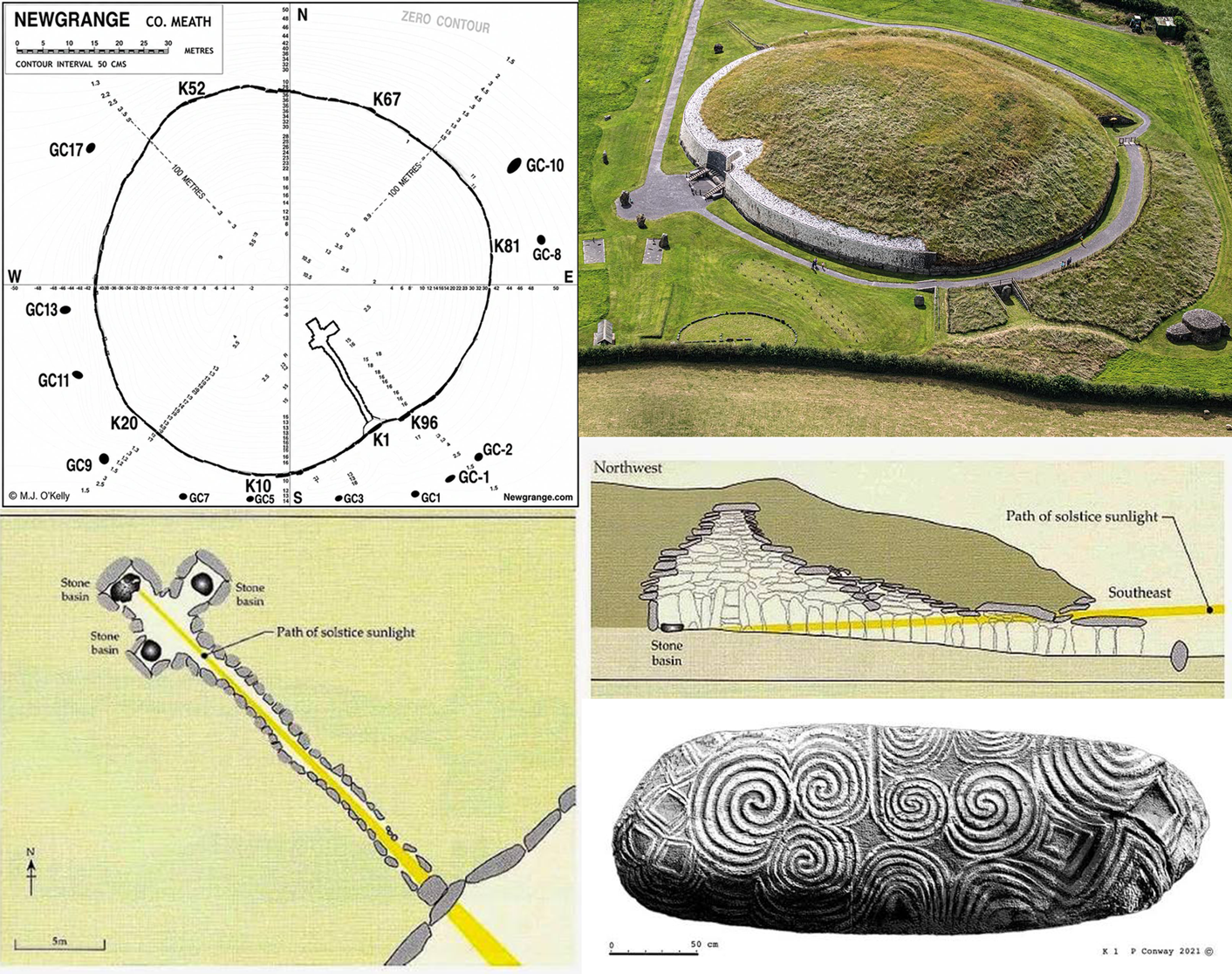
Predating Stonehenge and the Pyramids of Giza, Newgrange was built around 3200 BC in Ireland’s Boyne Valley. Its builders were early farmers, but the religious foundations greatly predate agriculture, stretching back to the caves of the Paleolithic, where the body was first understood as both the source of life and the mystery of its renewal.
Anthropologist Marija Gimbutas read the passage tombs of western Europe as embodiments of the Goddess of Death and Regeneration. Newgrange is a special case: beneath its great rounded mound, a narrow stone passage extends approximately nineteen meters into an enclosed chamber, creating a clear image of a birth canal that connects the interior to the outside world. The mound therefore becomes the belly of the earth, the inner chamber its womb.
The placement of the dead within this structure gives the analogy its religious force, similarly to the homes at Lepenski Vir. The dead return inward, toward the maternal enclosure from which existence begins. The earth receives its children with the possibility of bringing them forth again.
A visible drama aligned with this interpretation occurs at the winter solstice, when the rising sun sends a narrow beam through an opening above the entrance. The light travels along the passage and reaches the chamber hidden within the mound. At the moment when the sun experiences its annual rebirth, sunlight enters the burial mound, as if fertilizing their spirits for rebirth.
What an engraved vulva concentrates into a sign, Newgrange expands into an encounter between the human body and the movement of the heavens. The solstice alignment required careful observation and deliberate construction. Its builders arranged, with walls decorated with ornate spiral designs, for the returning sun to reach the ancestral dead at a particular turning point in the year.
Newgrange thus stands as a culmination of a goddess-centered philosophy rooted in the Old Stone Age. The philosophy of reincarnation assumes that the source of birth is the ultimate destination of the dead. Here, it is expressed through the earth’s enclosing body and the sunlight that enters it, making the birth canal a passage toward immortality.
Reincarnation’s Continuity
Across the long arc of the Stone Age, the feminine and maternal body represented a way to think about mortality itself. The form that opens to bring a child into the world is the same form that receives the dead and holds the possibility of their return.
This is what gets lost when we explain away a Venus as prehistoric erotica or stop at the words fertility symbol. Fertility tells us something about the power these images draw on, but leaves open the larger question of what that power was imagined to do. Once the earth is understood through the body that bears the living, generation becomes a way of imagining immortality.
In late medieval England, women in labor wore birthing girdles bearing images of Christ’s pierced side—a much later manifestation of the same principle. The striking resemblance between the wound and a vulva is well-known, but its use tells us more than its shape. A woman in childbirth could draw protection from the wound of a dying god. In a religion whose central promise is resurrection, an opening made in death was brought to the body through which a child would enter the world.
The woman wearing that girdle lived in a different religious world, yet her practice still makes visible the same association that gives the passage tomb its force. Birth could disclose something about death because it offered an experience of life coming forth from a place of mysterious and generative darkness.

Support future books, translations, and deeper research. Essays remain free, and paid subscribers get full access to Keys to the Library.
Works Cited & Further Reading
Joan Marler — “The Body of Woman as Sacred Metaphor.”
Marija Gimbutas — The Language of the Goddess (1989); The Living Goddesses (1999).
Richard Rudgley — The Lost Civilizations of the Stone Age (1999).
Merlin Stone — When God Was a Woman (1976), pp. 13–15.
Stefan Cvetković — Slavic Traditions & Mythology.
Patricia C. Rice — “Prehistoric Venuses: Symbols of Motherhood or Womanhood?” (1981).
Olga Soffer et al. — “The ‘Venus’ Figurines: Textiles, Basketry, Gender, and Status in the Upper Paleolithic.” (2000).
Catherine Hodge McCoid and LeRoy D. McDermott — “Toward Decolonizing Gender: Female Vision in the Upper Paleolithic.” American Anthropologist 98, no. 2 (1996)
Robert G. Bednarik — “The Interpretation of Cupules.” (2010).
Africa Pitarch Martí et al. — “The Symbolic Role of the Underground World among Middle Paleolithic Neanderthals.” (2021).
Randall White et al. — “Context and Dating of Aurignacian Vulvar Representations from Abri Castanet, France.” (2012).
Dušan Borić — “Body Metamorphosis and Animality.” (2005); with colleagues, “High-Resolution AMS Dating of Architecture, Boulder Artworks and the Transition to Farming at Lepenski Vir.” (2018).
French Ministry of Culture — Chauvet Cave: “Vulva Panel” and “Venus Pendant.”
Heritage Ireland — Brú na Bóinne: Newgrange, Knowth and Dowth.
Don Hitchcock, Don’s Maps — “The Vulva in Stone Age Art”; “The Venus of Laussel”; “Rock Art Depicting Females in the Americas.”
Christian-Georges Schwentzel — “When Did the Vulva Become Obscene?” The Conversation (2020).
toni's curiosity cabinet — “vulva imagery in religious and medieval art.”