

Our story begins in a world that erupted and broke beneath the feet of those who walked before us. Having roamed the Northern Hemisphere for nearly half a million years, Neanderthals endured some of the most significant natural disasters in the geological record.
In the face of these destructive events and rebirth, stories and rituals took on deeper meaning, broadening their application beyond the individual to the most tangibly arresting realities of global catastrophe.
We’re aware of Neanderthal bones, tools, and the caves they painted and arranged. But what did they make of the Earth’s fury? When the sky darkened and the land trembled, when fire rained from the heavens or the seas swallowed the shore, did they cower, or did they stand and watch, trying to make sense of it all?
To understand the Neanderthal story, we have to look at the forces that pressed in on it—a world of upheaval and uncertainty, shaped as much by catastrophe as by the minds that struggled to comprehend it, and whose traces remain long after they slipped from the archaeological record.
Supereruptions
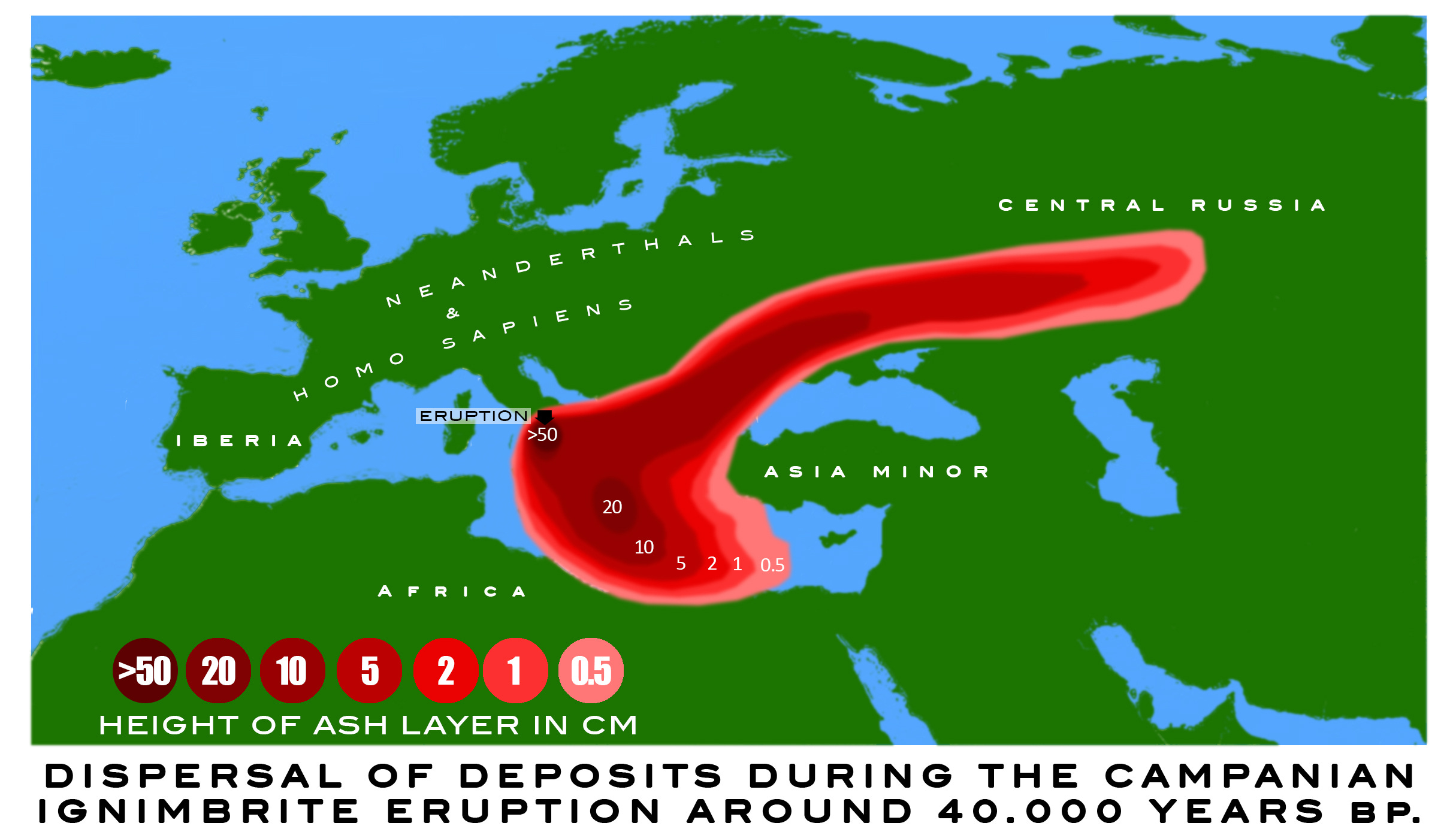
One of the greatest disasters in prehistoric Europe was the Campanian Ignimbrite eruption (~39,000 years ago). It came from the depths of the Phlegraean Fields, a supervolcanic complex in what is now southern Italy. The explosion was hundreds of times more powerful than Mount St. Helens and covered Europe in a choking veil of ash. Sulfur aerosols likely triggered sharp short-term cooling and disrupted photosynthesis across the continent.
This was Neanderthals’ own Pompeii, though it did not unfold in a single moment. Some likely survived the devastation, fleeing to less-affected regions. Others would have perished as the forests died and the herds they relied upon vanished. Across much of their range, populations were compressed into fewer habitable zones, breaking connections between groups and leaving survivors in a harsher, more uncertain world.
Long before this, the Youngest Toba eruption (~74,000 years ago) had already shown how fragile such systems could be. Though centered in South Asia, its climatic effect rippled outward, cooling environments and stressing populations at the edges of their range. Neanderthals in Europe may have escaped the worst of it, but Toba may well have thinned their numbers, eroding their hold on marginal lands and sharpening the precariousness of survival.
Climate whiplash
The Ice Age was a world in motion.
Throughout the last glacial period, the North Atlantic was punctuated by sudden calving of immense armadas of icebergs that flooded the ocean with meltwater known as “Heinrich events.” These episodes disrupted the currents that warmed Europe, triggering prolonged cold on timescales far more rapid than anything seen in the last 12,000 years (since the dawn of the Holocene).
For Neanderthals, these were invisible catastrophes. Wooded regions thinned into open, wind-scoured ground, animal populations shifted or disappeared, and once-familiar territories grew increasingly difficult to navigate or rely upon. Survival depended on constant movement across a dynamic landscape.
Water reshaped that world as well. As ice sheets advanced and retreated, coastlines shifted dramatically, exposing and submerging vast lowland plains. Regions that had once supported human life disappeared beneath rising seas, while others emerged only temporarily before being lost again. Low-lying landscapes—such as Doggerland, the broad plain that once connected Britain to mainland Europe beneath what is now the North Sea—formed part of this unstable geography. They have been alternately revealed and erased over generations, sinking whatever traces Neanderthals and others left behind.
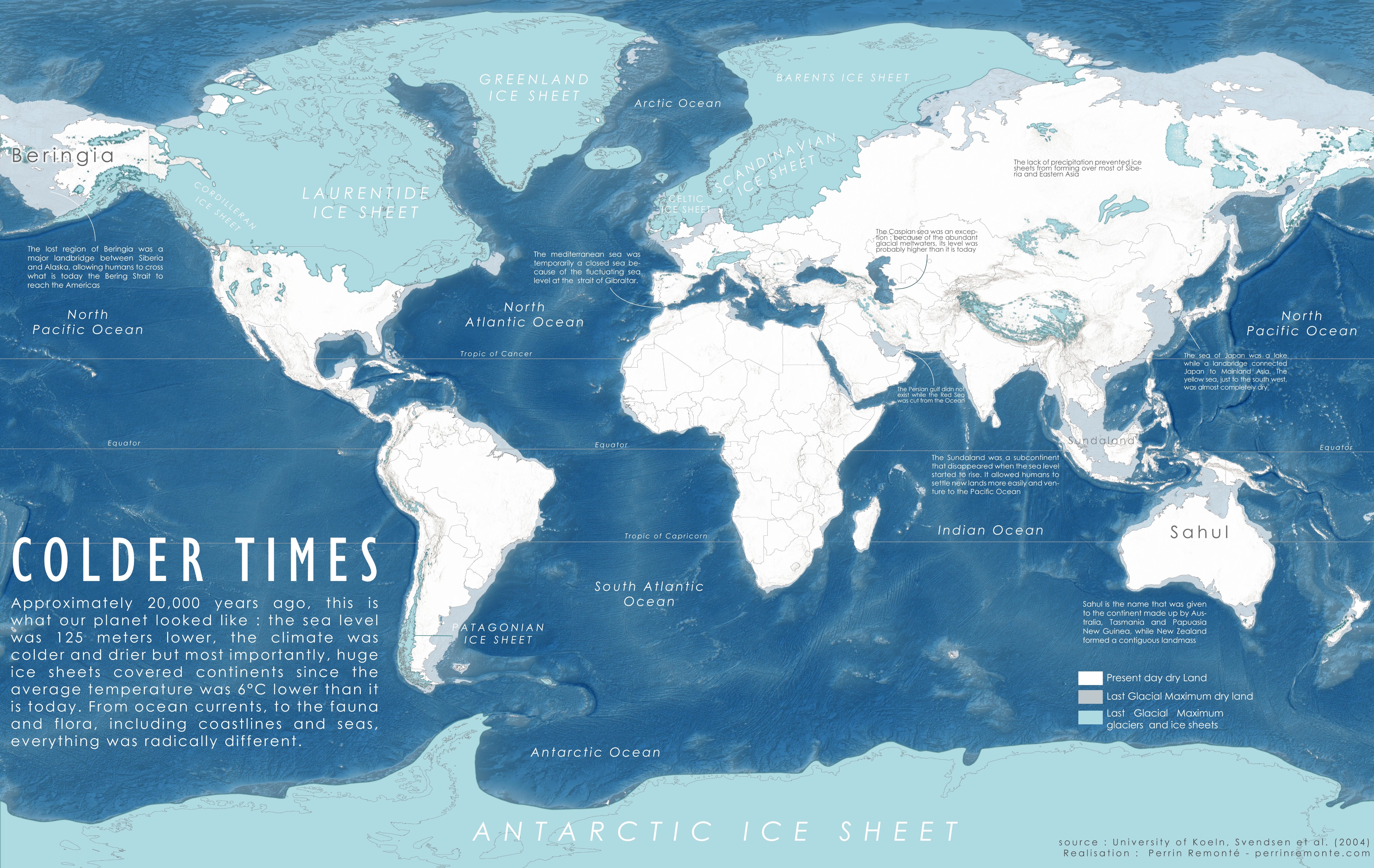
The end of the Ice Age unfolded through sudden cold snaps triggered by meltwater disrupting ocean circulation. These cycles of freezing and flooding fractured ecosystems and scattered populations, leaving little time for recovery.
Two of the most severe events, Heinrich 5 (~45,000 years ago) and Heinrich 4 (~38,000 years ago), struck in the twilight of Neanderthal existence. These disruptions forced populations into shrinking refuges and drove movement across increasingly constrained terrain.
What did such instability do to memory, to tradition? When landscapes could vanish within generations, what remained fixed enough to pass on?
Hybridization
As the climate tightened its grip on the north, Neanderthals drifted toward the southern margins of Europe, North Africa, and the Levant, where conditions remained comparatively stable. Over time, these temperate regions continued to draw different human groups together. Proximity accumulated until separation itself became difficult to maintain.
The eastern Mediterranean preserves some of the clearest traces of this overlap. Fossils from sites in what is now Israel point to early modern humans living within a broader region long associated with Neanderthals, their presence extending across the same ecological zones over long stretches of time. These encounters unfolded across generations, leaving behind a legacy that remains visible at the genetic level. Neanderthal DNA persists in most modern humans outside of Africa, carried forward through repeated episodes of interbreeding as populations expanded and contracted across Eurasia.
Across this same span, the material record begins to thicken. Objects associated with personal adornment appear with greater frequency, pigments are used more consistently, and marks accumulate on cave walls and artifacts in ways that suggest attention to meaning, identity, and memory. Neanderthals had already worked with pigments and selected objects in ways that imply symbolic awareness, while early modern humans were developing their own practices. In regions of overlap, the density of such activity increases, as proximity reshaped how meaning was made and shared.
Over time, the conditions that sustained Neanderthals as a distinct population became harder to maintain. Their lineage did not disappear, but it did not remain unchanged. It was carried forward, absorbed into a broader and more fluid human landscape.
Why We Deny Erasure
In the nineteenth century, scientific understanding shifted from “catastrophism” to “uniformitarianism.” The former, eventually overshadowed by its close proximity to the Biblical flood, perceived deep antiquity through the lens of various cycles of destruction and rebirth.
When Charles Lyell described a world shaped by slow, continuous processes in Principles of Geology, his model made the past legible by aligning it with the present: what is observable in our time is most likely to be mirrored across time. It opened the door to evolutionary thinking and deepened the timeline of the Earth. At the same time, it smoothed over the violence of the past, giving the impression that what was lost had already been accounted for.
Before Lyell, earlier scholars tried to account for the visible traces of upheaval. Marine fossils found far inland and layers of sediment suggested that water had once covered regions now dry. These observations were often gathered under the idea of a great flood, interpreted through Biblical narrative. The explanations were incomplete, but they recognized something real: the Earth had not always changed gently.
The deeper record of the Ice Age reflects this more volatile reality. Periods of relative stability give way to sudden shifts in sea level and climate on the timescale within which Neanderthals lived, forcing adaptation within a few generations. Survival depended on constant adjustment to environments that would not remain fixed.
The record does not end with these events. The Laacher See eruption (~13,000 years ago) would again blanket parts of Europe in ash. Evidence has been proposed for a possible extraterrestrial impact around 12,900 years ago, coinciding with an abrupt climatic reversal. Tree-ring data point to a solar storm of extraordinary magnitude roughly 14,300 years ago, capable of altering atmospheric conditions on a continental scale. Even earlier, genetic evidence suggests a sharp decline in Neanderthal diversity around 110,000 years ago, pointing to population stress long before their final absorption. Taken together, these episodes suggest not a stable background punctuated by rare disaster, but a world repeatedly interrupted by it.
The Neanderthal worldview was formed under these conditions of instability. It did not end with them. It continued through the populations that followed, shaping how change was understood and remembered. The cyclical view of destruction and renewal that appears in later myth and religion was inherited from a deep human past in which survival depended on recognizing that the world does not move in straight lines, and never has.
Works Cited & Further Reading
Black, B. A., et al. (2015). Campanian Ignimbrite eruption and its climatic consequences. Journal of Volcanology and Geothermal Research.
Riede, F. (2017). Laacher See eruption and its impact on European hunter-gatherers. Quaternary International.
Firestone, R. B., et al. (2007). Evidence for an extraterrestrial impact 12,900 years ago and climatic implications. Proceedings of the National Academy of Sciences.