

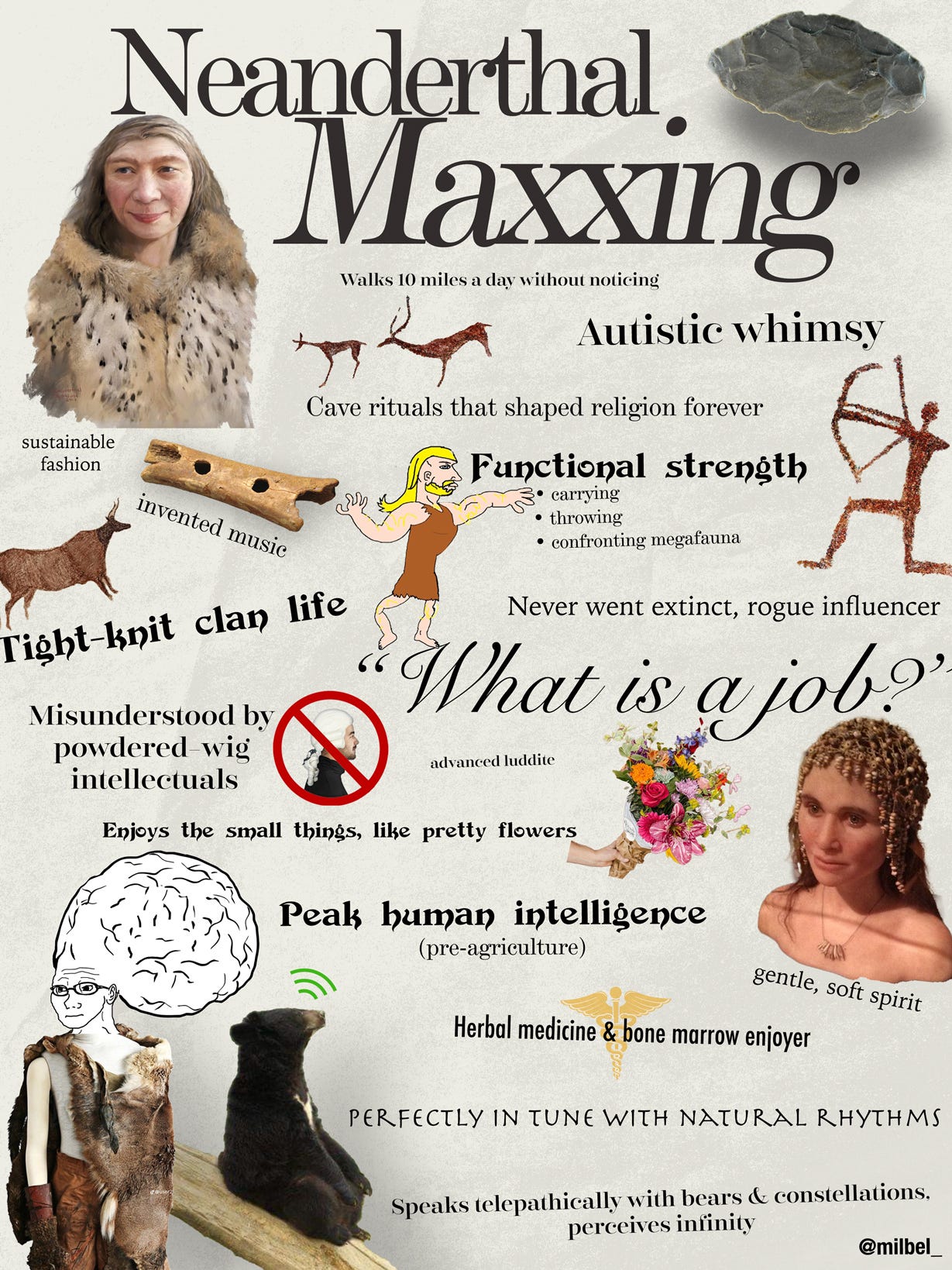
Every wellness trend points back to the basics: get in tune with the earth and cosmos. Learn to enjoy your own company, and keep your circle tight. Keep yourself strong, but don’t get distracted by the pursuit of aesthetic perfection. Consume less and better. Choose local, cook at home. Slow down, tune in, be intentional. Get off that damn phone.
Get in touch with something higher—something spiritually fulfilling. Humble yourself before the great mysteries of life, love, and death.
We can try to learn from our favorite influencers, creatives, thinkers, or opium-addled stoic philosophers. Or, we could look to our deep ancestral past, where a sensitive but robust nomadic people lived harmoniously with nature’s most unforgiving mood swings for half a million years. Would it be a far-fetched utopian fallacy to claim Neanderthals are the true fulfillment of the Rousseauian “noble savage” ideation, or would it be insanely true?
We may never know, we would do well to reintroduce some of the conditions we evolved for…
Dawn
Let’s start at sunrise.
You might default to a pastoral scene of more recent memory, like a farmhouse. My great-grandparents were farmers, and there’s been a collective spirit of longing for that simplicity in the family ever since. But let’s not get sappy: hunter-gatherers rose with the sun for millions of years before a row was ever tilled. In fact, the urge to settle that instigated this whole “agriculture” thing was our first step into hell. Civilization came in hot on the farmer’s tail, and we all know how that ended up. Mankind has never been the same; slowly self-domesticating into a sad poodle of a hominid, unable to remember his one-time login code for long enough to switch apps and type it in. Thanks, Early European Farmers.
No—in the forests and plains of the Old Stone Age, there were no landlords, no crop blights, far less tooth decay, and fewer signs of widespread physical degeneration. There was the looming threat of being dismembered or gorged by giant mammalian super-predators, but these are risks we’re willing to take for a free and fulfilled life. As the sun prepared to creep over the horizon, humanity was roused awake naturally, like the rest of the earth’s daytime creatures.
Waking up as a response, not a task, is an essential function of the healthy human. It guarantees circadian regulation, low cortisol, heightened sensory attunement, and increased reaction time for those pesky cave hyenas and dire wolves. Being forced awake during your developmental years can disrupt the natural calibration of the body’s internal clock, desynchronizing sleep cycles, hormone release, and even cognitive performance later in life.
Modern chronobiology has made it clear: the human organism is tuned to light. As the sun rises, cortisol increases gradually, body temperature rises, and melatonin recedes. The body prepares itself, without instruction, for awareness and movement. This is a simple baseline function that has been proven in studies of contemporary hunter-gatherer groups. Ideal sleep follows environmental cues like light, temperature, and social rhythm, which cause people to fall asleep and wake gradually.
Instead of being jolted awake by sudden noise and expected to spring into action without any leverage for proper orientation, hunter-gatherers ease into the morning, often waking before sunrise, as the world begins to stir around them. There is no abrupt transition, only a shift from rest into awareness. We will wake up this morning not to immediately chase that bread, but to find the bread in good time.
Coffee will not be on the menu for several millennia. Perhaps some mint tea.
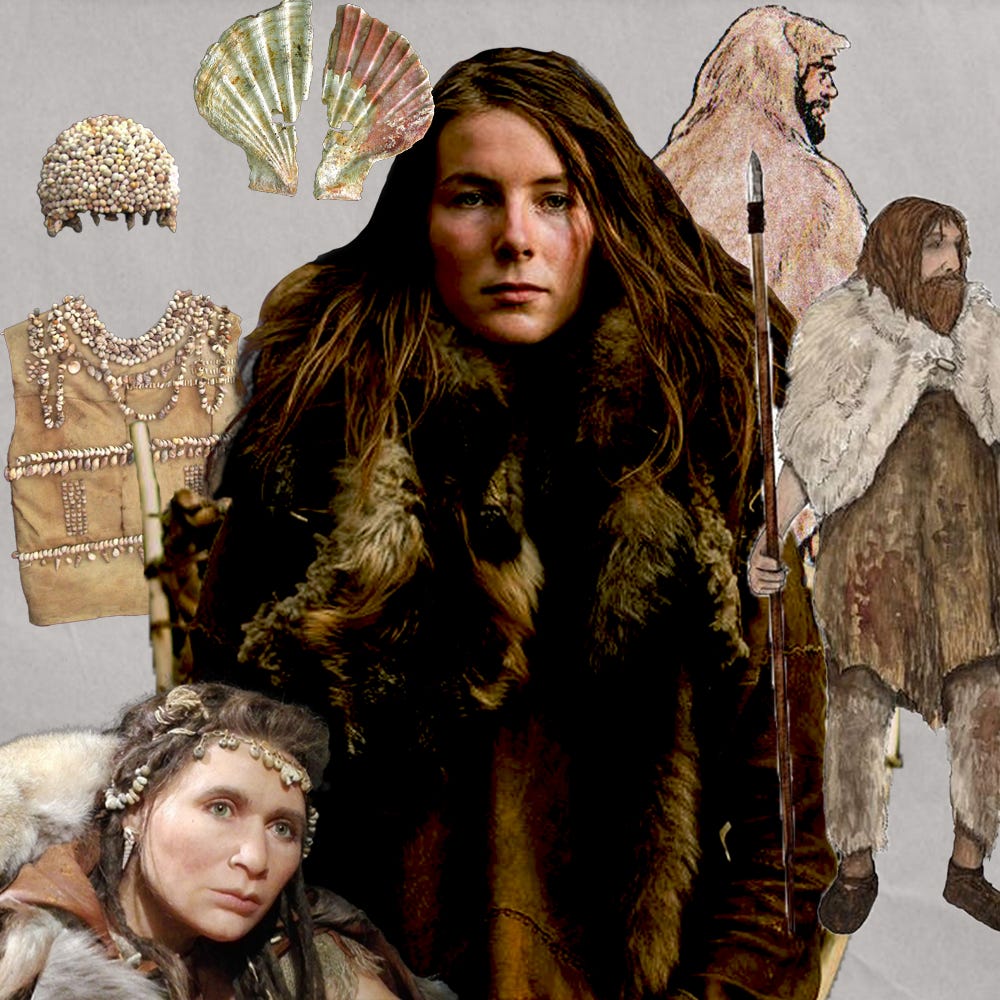
Motion
“In working with a piece of flint or primitive needle, in joining together animal hides or wooden planks, in preparing a fishhook or an arrowhead, in shaping a clay statuette, the imagination discovers unsuspected analogies among the different levels of the real; tools and objects are laden with countless symbolisms, the world of work—the micro-universe that absorbs the artisan’s attention for long hours—becomes a mysterious and sacred center, rich in meaning.” Mircea Eliade
The bison won’t hunt themselves.
It’s not a daily grind: Neanderthals alter their activity and diet seasonally, like other animals, or like a locally-sourced artisan restaurant. But once the ice recedes—if only partially since we are dealing with an Ice Age—it would behoove us to stock up on game, not a smidgen of which will go to waste. What is taken must be taken seriously.
The key to a successful hunt is teamwork, foresight, and coordination—all strong suits for the Neanderthal brain. Having endured the northern hemisphere for hundreds of thousands of years of Ice Age climates and cataclysms, planning ahead became an evolutionary must.
But more importantly than any plan is the execution. Without reliable tribesmen, the level of hunting (especially megafauna) required to stay fed through a long winter could not be achieved. Neanderthal brains were adapted for socialization with small, tight-knit groups; anything outside of which would be met tentatively, that is to say, awkwardly. But together, the tribe collaborated ingeniously to survive long, brutal winters. Trust ran deep because otherwise the tribe would die. Think of it like the bond between veterans who fought together in war. An Ice Age trauma bond.
Physically, Neanderthals were suited for cold weather, with stockier frames that conserved heat and supported powerful, full-body exertion. Hunting large game at close range required strength that could be applied under pressure. Lifting, carrying, striking, and endurance were practiced continuously and with consequence—the perfect example of integrated, functional strength.
When winter got too rough for survival, Neanderthals migrated south. Hunter-gatherer society is a lot more nimble, not reliant on permanent settlements, and therefore able, in this case, to traverse wide geographical expanses without drastically sacrificing lifestyle, making them adaptable and resilient.
It was also these migrations that likely introduced Neanderthals to Homo Sapiens in the Levant and Northern Africa, resulting in early hybridization that would go on to determine the fate of our species.
But that’s a discussion for a different day.
Diet
The “Paleo diet”, devised in the mid-1970s and popularized in the 90s, was based on the idea that our Stone Age ancestors regularly consumed a high-protein, low-carbohydrate diet. At its core, it rests on a compelling observation: that our modern diet is out of alignment with the conditions under which we evolved. In that sense, it is not wrong, but it is incomplete.
In recent years, this idea has been pushed even further, rebranding itself in some circles as a purely meat-based “carnivore” diet. Now—eat whatever works for you—but if we are looking to Neanderthals as our model, the record tells a different story.
Their food intake was never fixed, but seasonal, regional, and opportunistic. Large game certainly played a major role, particularly in colder climates, but evidence from dental calculus and residue analysis shows that they also consumed plant foods, including starches, seeds, and occasionally sugars from fruits or honey, along with cooked carbohydrates when available. Their diet expanded and contracted with the environment, rather than adhering to a single principle.
And whatever they were doing, it worked.
Skeletal remains show physically robust individuals, with strong bones and relatively low rates of chronic degeneration. Tooth decay, while not absent, appears far less common than in post-agricultural populations. There is also evidence that Neanderthals used plants for medicinal purposes, suggesting a level of dietary awareness that went beyond simple consumption.
Food existed within the environment itself, encountered as needed, prepared, and shared within the rhythms of daily life, never taken to the point where nature suffered a deficit by their hands.
The Neanderthal diet cannot be reconstructed in any literal sense, but its variable structure—shaped by conditions rather than imposed upon them—can still be recognized. In that sense, it was less a diet than a relationship.
Free time
“Whereas modern man builds cities of stone…Neanderthal was content to build cities of dreams.” Stan Gooch
For the conveniences and technology we enjoy, we pay a hefty price.
The average working adult, after 45 hours locked in, 50 hours sleeping, and however many hours are needed for meals, chores, and exercise, has very little meaningful free time, and what he does have, he’d often prefer to spend relaxing.
Still, you might ask, what is there to show for so much free time compounded over hundreds of thousands of years? The vast majority of our society may feel their time is not their own, but their Paleolithic counterparts never invented airplanes, industrial systems, or striped toothpaste. The archaeological record is quiet. But silence is not absence; it merely suggests attention directed elsewhere. Unlike the medieval peasantry, who still enjoyed leagues more free time than we do, Neanderthals were deeply creative, just not in the way we associate with advancement today.
For hunter-gatherers, “work” is largely just what it takes to survive, if it could be separated into its own category at all. The concept of expansion was applied to the same end: maximizing quality of life and thereby survival, but not in the way we think in a post-agricultural society. Progress was not counted in numbers, but in depth. The dream culture of Neanderthals survives today in our collective unconscious through the various customs we practice and stories we tell. The continuity of northern cultures from a common ancestor makes it clear.
So, no, they may not have left behind megalithic structures, but their predecessor, the cave, is the cornerstone of Neanderthal ritual life.
And it’s where we will wrap our journey.
Dusk
A group sits in the half-light, the fire low, the walls alive with movement. Someone begins a story that has been told before, though never quite the same way twice.
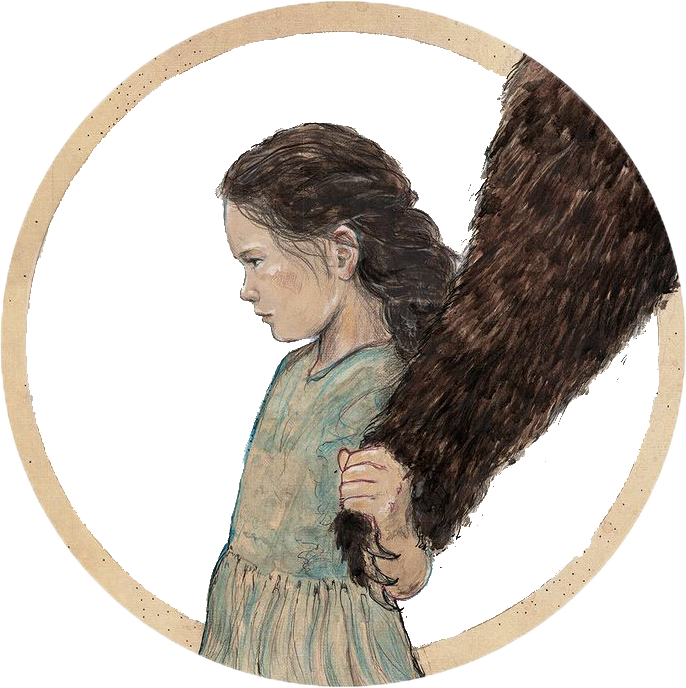
Neanderthals were making fires 400,000 years ago. The flickering flames made cave paintings dance. Stories were passed down from memory, encoded with practical and esoteric knowledge. The dead were honored with funerary rites. The association with death and new life in pagan cultures suggests that in the caves where burials took place, initiation rituals may have been performed—child initiates exiting the yonic cave inhabited by the ancestral spirit.
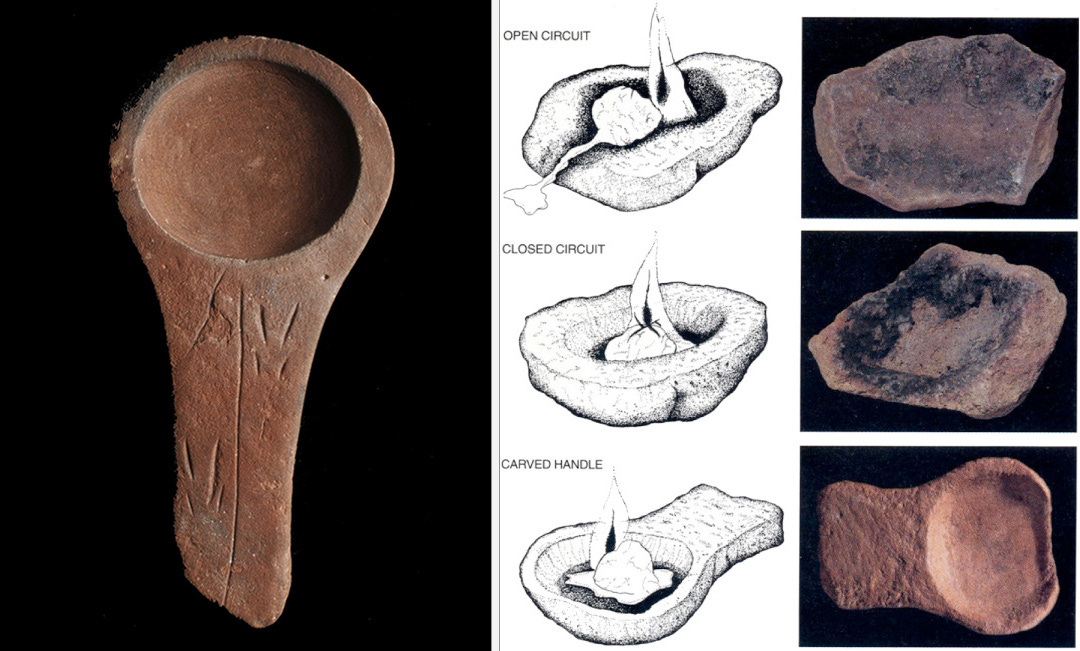
We don’t know how old surviving ancient fairy tales, myths, and customs are. But their structure—the descent into darkness, the encounter with something other, the return—can already be glimpsed in the earliest human environments, with an unbroken lineage carrying on through the ages in animistic cultures across the world.
“Neanderthal paganism” might lack the widely accepted framework that has labeled Neanderthals the evolutionary “missing link” between apes and ourselves, but the anthropological lineage that constructs it remains scattered. It just needs melding. Cohesion.
Our remote ancestors will get the respect they deserve, and they get closer with every new Neanderthal appreciator. Their way of life may be out of reach, but something of it remains in us.
Works Cited & Further Reading
Weston A. Price, 1939 – Nutrition and Physical Degeneration
Stan Gooch, 2006 – The Dream Culture of the Neanderthals
Mircea Eliade, 1976 – A History of Religious Ideas, Vol. I
NYT, December 2025: Archaeologists Find Oldest Evidence of Fire-Making
Annual Review of Anthropology, 1995: Biological Changes in Human Populations with Agriculture
Journal of Anthropological Research, 1980: Time and Leisure in the Elaboration of Culture
Sapiens, 2019: The Neanderthal Diet—From Teeth to Guts
Oxford, 2023: Archaic Introgression Shaped Human Circadian Traits
Patheos, 2023: Evidence of a Neanderthal religion dates back 175,000 years
Love it! When I’m camping it’s amazing how quickly I tune back into waking at sunrise. And of course gathering around a fire at dusk. Best feeling in the world.
incredible article as always, thank you so much for sharing