

Note: This series launches alongside a new supporter tier. The first installment will remain open. After that, full access will be for paid subscribers. Essays stay free. Support helps fund future books, videos, and research.
“The history of man for the nine months preceding his birth would, probably, be far more interesting and contain events of greater moment than all the three score and ten years that follow it.” —Samuel Taylor Coleridge
Hello neander-maxxers.
Welcome to Keys to the Library, where I repress the urge to gatekeep my ever-growing collection of esoteric tomes, share some insight into the research and writing behind this page, and discuss upcoming work and projects.
Today we’re exploring a lesser-known discipline central to my research. Prenatal psychology investigates how experiences before and during birth shape our psychological development, behavior, and emotional lives.
Long before psychologists began exploring prenatal mysteries, ancient religious traditions linked the generation of life to the generation of the cosmos itself. Drawing on the work of historian of religion Bruno Hugo Stricker, Swiss psychologist Franz Renggli suggests that Ancient Egyptians saw the child’s development within the mother as a key to understanding the origins of the world. Birth belonged at the center of the cosmic drama, shaping the earliest conceptions of rebirth and immortality.
The literature assembled here approaches beginnings from another direction, asking how much of their influence might persist throughout our lives. Along the way, several of these writers traced connections between dream symbolism, prenatal imagery, and mythological patterns whose origins disappear into prehistory.
The modern study of prenatal psychology has opened an unexpected passage into an ancient way of imagining the world—as if, while exploring the mind, we stepped on a stone in a temple floor and unlocked a trapdoor.
The door is open. Let’s walk through it.
Otto Rank — The Trauma of Birth (1924)

“Rank came out with a proposal that sounds like a translation into psychoanalytic jargon from Australian Aboriginal myths of the dream world before birth. He proposed that the core of the unconscious is based on our relations in and to the womb; that not only or primarily birth but the whole of the prenatal epoch from conception to birth is recapitulated from the beginning to the end of psychoanalysis.”1
A foundational work. Rank (1884-1939), once one of Freud’s closest collaborators, placed the decisive psychological rupture at birth. He proposed that this first ordeal supplies the underlying pattern for later anxiety. This shifted the emphasis from the Oedipal conflicts of childhood toward an earlier relationship with the maternal body, which brought about his break with Freud that led to his removal from the Vienna Psychoanalytic Society two years after its publication.2
For Rank, birth supplies the original experience of anxiety, whose influence persists even when the event itself cannot be consciously remembered. He understood neurotic symptoms as repetitions of, or defenses against, this first separation from the maternal body. The attachment to intrauterine life therefore remains central to his account, with later fears and desires organized around the ordeal of leaving it and the longing to recover its security. He extends this argument beyond clinical psychology into myth, religion, and art, treating the consequences of birth as a force in cultural as well as individual life.
My primary criticism is the contrast between a peaceful womb and a traumatic birth. It leaves too little room for prenatal distress, or for birth as a release from that distress—a triumphant experience as well as a traumatic one.
Writing a century ago, Rank gave birth an enormous explanatory burden, leaving plenty for later writers to question and expand. His work establishes a question that returns throughout this reading list: how much of our emotional and symbolic life is organized around an experience we cannot ordinarily remember?
Nandor Fodor — The Search for the Beloved (1949)

“The fear of death originates in the fear of birth; that the panicky journey through the uterine passage is an experience in dying; and that we are haunted more by the projected memory of this trial of body and soul than by the dread of future extinction.”3
Twenty-five years after The Trauma of Birth, Nandor Fodor (1895-1964) returned to a marginalized subject. The Search for the Beloved developed Rank’s argument through an extensive collection of clinical material, exploring how birth and prenatal experience might persist in adult dreams, fears, and relationships.
While ultimately arriving at similar conclusions to Rank, what distinguishes Fodor is his dream interpretations. Fodor interprets nightmares of suffocation, falling, and confinement as possible expressions of the birth ordeal, with bodily sensations returning in disguised narrative form. Fodor also explored prenatal conditioning, asking how the mother’s emotional life might affect the unborn child—something many would take for granted, but which researchers were only beginning to investigate systematically.
Read Fodor for his rich clinical interpretations and as a bridge to Francis J. Mott, whose work takes the relationship between prenatal experience and myth much further.
Francis J. Mott — The Nature of the Self (1959)

See also: Mythology of the Prenatal Life (1960); The Universal Design of Creation (1964)
“A new epistemology has been rendered possible by the fact that the mind which knows is demonstrated to have the same formative basis as the phenomena which it knows.”4
Starting as a psychoanalyst, Mott (1901-1980) recognized prenatal imagery in his clients’ dreams from his familiarity with Rank and Fodor’s work. He began incorporating observations of the relationship between the fetus and placenta, the effect of the amniotic water, and the unique biology of the fetal skin into his own psychological theories.
For me, there are two aspects of Mott’s work that make it S-tier. One is his spiritual enthusiasm about nature’s patterns. Like ancient cultures, he saw patterns in nature as proof of universal and intelligent design, and believed the microcosm reflected the macro in inorganic, organic, and social sciences alike. Secondly, he handled mythological material with reverence—not as an evolved modern scientist, but as a fellow inquirer.
The unmistakable overlap between dreams (private symbology) and myth (collective symbology) opened a door of interpretation that gets us closer, in my opinion, to the purpose of myth than most other approaches, whether they be purely psychological, historical, or moral.
New editions of The Nature of the Self and Mythology of the Prenatal Life are still available thanks to Melanie Reinhart at Starwalker Press. The others are out of print, but I have been acquiring them slowly and incorporating them into essays like The Myth of the Shining One.
D.W. Winnicott & R.D. Laing

Winnicott — “Birth Memories, Birth Trauma, and Anxiety” (1949)
Laing — The Facts of Life (1976); The Voice of Experience (1982)
“There is evidence that personal birth experience is significant and is held as memory material. When birth trauma is significant, every detail of impingement and reaction is, as it were, etched on the patient’s memory, in the way to which we have been accustomed when patients relive traumatic experiences of later life.”5
I discovered Mott through R. D. Laing (1927-1989), and for that I am forever grateful. Laing’s engagement with this obscure writer went well beyond a passing reference. His handwritten annotations appear in the restored edition of Mythology of the Prenatal Life, giving us the unusual opportunity to read Mott alongside another psychiatrist thinking through his implications. In Laing’s own work, prenatal life becomes part of a larger question about the relationship between our biological beginnings and our experience of being a person.
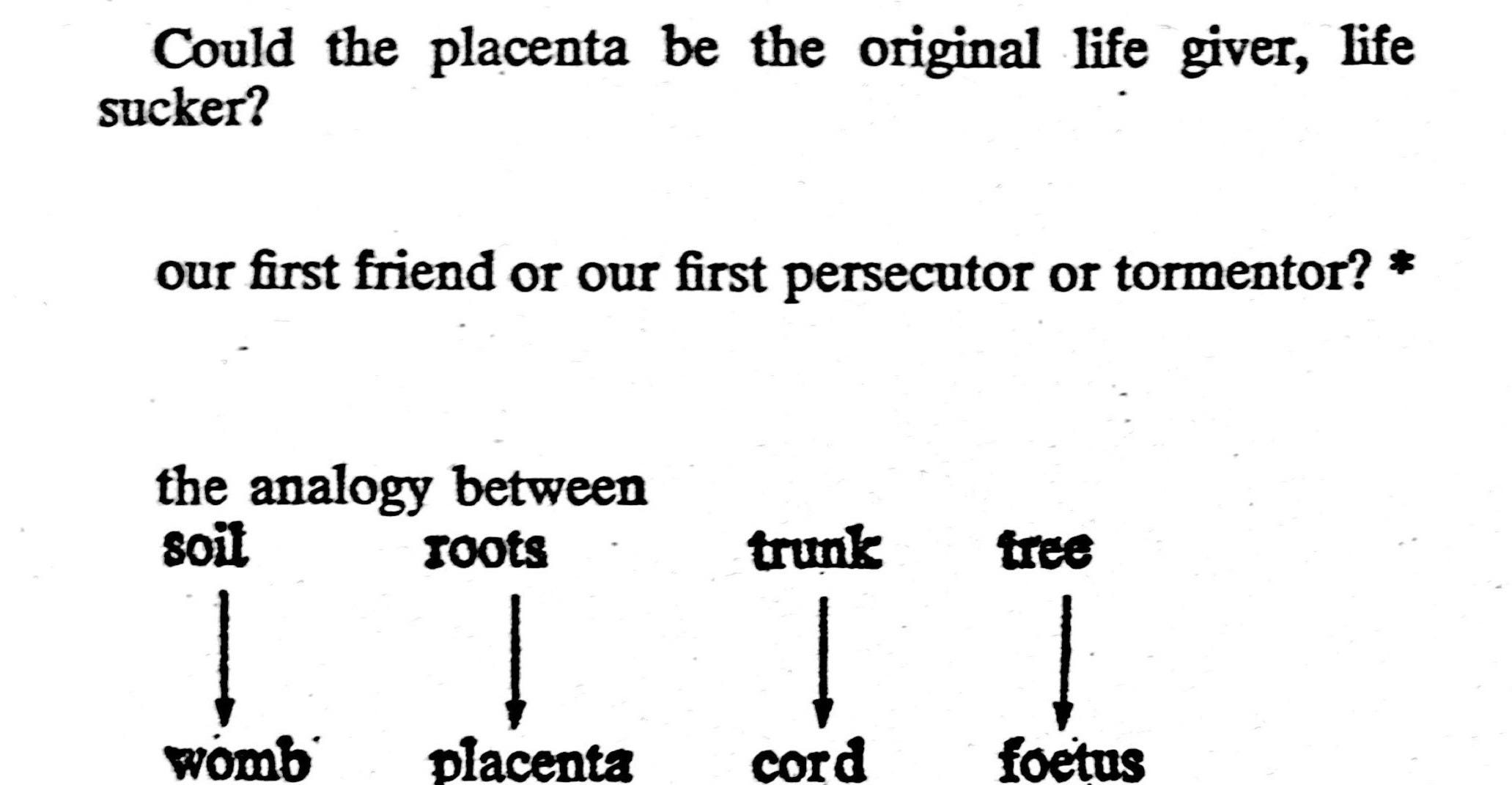
An earlier contribution comes from D. W. Winnicott (1896-1971), one of Laing’s clinical supervisors. His essay “Birth Memories, Birth Trauma, and Anxiety” asks what birth might be like from the infant’s perspective and how its impressions could persist. Crucially, he distinguishes birth from birth trauma. A normal birth could contribute to the infant’s developing sense of continuity, while an overwhelming ordeal could disrupt it. He interpreted certain patterns in his patients’ play and bodily reactions as possible traces of these experiences, placing birth within a developmental history rather than making it the explanation for everything.
Laing approaches the subject with a more abstract sensibility. Inspired by Mott, he employs mythological analogy, explores the role of the placenta and umbilical cord, and criticizes the aspects of modernization in birth practice that turn mother into patient and experience into procedure.
More on that in this short documentary from 1978:
Stanislav Grof — Realms of the Human Unconscious (1975)

Grof brings the birth-trauma question into the setting of LSD psychotherapy. Where Fodor and Mott worked extensively with dreams, Grof encountered patients who felt they were undergoing birth itself, with intense bodily sensations unfolding alongside elaborate symbolic imagery. Realms of the Human Unconscious gathers his observations into a model in which birth occupies an important position between personal biography and experiences that seem to reach beyond the individual.
His best-known contribution is the four Basic Perinatal Matrices, which distinguish intrauterine life from successive phases of labor and delivery. The crucial distinction is between confinement with no apparent escape and a struggle in which escape becomes possible. In Grof’s interpretation, these conditions carry different psychological worlds. The former can take the form of hopeless imprisonment or eternal damnation; the latter becomes an overwhelming struggle toward release. Birth thus supplies more than a single traumatic rupture. It provides a sequence in which suffering can culminate in liberation, giving the ordeal the triumphant dimension missing from an exclusively traumatic account.
This extends the connection between bodily experience and symbolic life explored by Mott. Grof describes sessions in which physical distress and religious imagery appear together, as though the personal ordeal has assumed a cosmic scale. His interpretation places birth at the meeting point of the biological and the spiritual, helping explain why rebirth can be experienced as something far more consequential than a metaphor. Whether these episodes recover birth memories remains unresolved, but the reported relationship between bodily sensation and symbolic experience makes this a noteworthy study at the very least.
Ludwig Janus and Later Perspectives

“Many traces of pre- and perinatal events are preserved in mythological stories and in rites of passage. The baby’s experience of its own placenta is expressed explicitly in stories in which the placenta is described as brother, guardian spirit, or source of power.”6
Ludwig Janus brings this tradition into conversation with more recent developmental research. The Enduring Effects of Prenatal Experience (1997) moves between developmental research and psychoanalytic interpretation, offering a broad introduction to the field while retaining the interest in symbolic life that makes these questions especially compelling. If you want one book that surveys the territory covered here, this is a useful starting point.
His substantial chapter on cultural expression explores initiation as a symbolic return to the womb and considers the fairy-tale hero’s journey into another world as an image of life’s beginnings. These interpretations continue the inquiry developed by Rank and Mott, placing individual development alongside the stories through which cultures understand transformation. The book’s breadth is its attraction.
For a complementary perspective, David Chamberlain’s Windows to the Womb (2013) turns toward the developing child’s capacities before birth, presenting his case for a richer prenatal mental life than is commonly imagined. The later Handbook of Prenatal and Perinatal Psychology, coedited by Janus, offers a more extensive reference for readers who want to follow the field into research and practice.
Further Reading & Viewing
A few more paths into the subject, including works that informed this list and others worth exploring. A KTL #1 Part ✌️ if you will.
Lloyd DeMause – Foundations of Psychohistory (1982)7
David Chamberlain — Babies Remember Birth: The Mind of Your Newborn Baby (1988)
Stephen M. Maret — The Prenatal Person: Frank Lake’s Maternal-Fetal Distress Syndrome (1997)8
Thomas R. Verny — The Secret Life of the Unborn Child (1981)
M. Lietaert Peerbolte — Prenatal Psychology (1954)
Dorota Kornas-Biela — The Beginnings of Prenatal Psychology in Poland (2017)
Peter Sloterdijk — Bubbles: Spheres Volume I: Microspherology (1998, English version 2011)
Translation Projects
I’m currently working through translations of some obscure works in prenatal psychology, including writings by Pierre Weil and Franz Renggli, to incorporate into my broader research. Some of these texts are out of print or have never received a published English translation.
Happy reading!
—M

Keys to the Library arrives on the third Friday of each month. Essays stay free.
Support funds future book and video production, and our collective ascent into a realm that transcends the boundary between religion and science, and makes our loved ones question our psychological well-being.
R.D. Laing, The Voice of Experience, 1982 p. 92
N. Fodor, The Search for the Beloved, 1949 p. 308
F. Mott, The Universal Design of Creation, 1964, p. 480
D.W. Winnicott, "Birth Memories, Birth Trauma and Anxiety"
L. Janus, The Enduring Effects of Prenatal Experience, 1998
I don't know about symbolic birth experiences, but until I was 7-8 or so (more when younger) I used to have recurring dreams where I'd push/be pushed through tight, pinky-white tunnels (or everything was pink-white, I wasnt clear) and come to somewhere brighter and vaguely pastel-coloured. They weren't very long or focussed dreams, but they felt safe, happy and I enjoyed them. I often described them to my parents, and called them my "somersault" dreams. Certainly wouldn't call them traumatic.
But apparently I had to be delivered in hospital, by forceps, after quite a prolonged birth.
Anyway, some.anecdotal evidence that birth can be "remembered" in dreams and it needn't be a bad memory. I'm not sure how that sits with the analysts...