

“For a striking new fact to receive attention, it must fit into a theory.” —Loren Eiseley
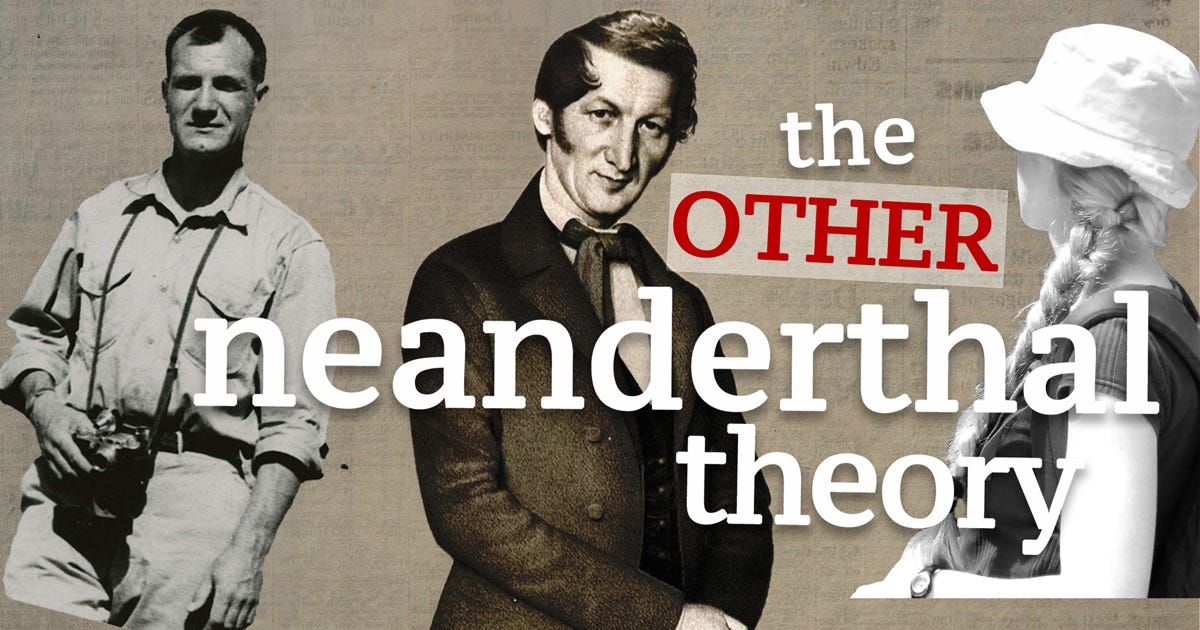
In prehistory and human origins, there is raw data, and there is interpretation. The former is a sparse collection of bone fragments and scattered tools, often leaving the heavy lifting to those tasked with constructing a coherent picture. The more significant the data, the more it shapes anthropological models. But the more entrenched an interpretation becomes, the more it shapes the expectations of the field, guiding what is sought, what is found, and how it is presented to the public.
In this way, certain interpretations become dominant, while others—equally plausible but less institutionally supported—remain in the background, rarely developing into full alternatives.
When Neanderthal remains were first discovered in the mid-19th century, they quickly became entangled in the emerging framework of evolutionary theory. Darwin himself had not yet addressed human origins, though many of his contemporaries interpreted the fossils through this new lens. Were these ancient humans, or something more primitive? The question was open, but the answers that followed would prove remarkably durable.
Within the first fifty years following their discovery, Neanderthals became fixed within the role of the “missing link” between man and ape—a lower species on the evolutionary ladder, primitive, transitional, “incapable of moral and theistic conceptions,” and an extinct, genetic dead-end. Early authority figures helped cement this image, and it persisted long after the original evidence had been reinterpreted. Even today, as more “progressive” anthropologists make revisions, granting Neanderthals intelligence, empathy, and some semblance of culture, these qualities are framed as partial or incomplete. Their ceiling remains below our own. The narrative appears to be challenged while remaining structurally intact.
But this interpretation was never uncontested. From the initial discovery onward, there were those who resisted the characterization of Neanderthals as brutish or inferior. Some pointed to anatomical evidence, others to behavior, intelligence, or even the possibility of direct continuity between Neanderthals and modern humans. In the absence of a model that could accommodate them, their suggestions were treated as isolated anomalies, easy to dismiss or forget altogether.
Only recently has the underlying data begun to shift in a way that demands a more fundamental reconsideration. Paleogenomic research has revealed that Neanderthals and other archaic humans are not simply extinct relatives, but contributors to the genetic makeup of modern populations. They are our ancestors. We have the raw data to prove that the boundary between “them” and “us” has blurred. Still, over fifteen years later, paleoanthropology hasn’t destabilized in any meaningful way. There hasn’t been an equal reaction to the gravity of the new information.
Those who challenged the dominant interpretation of Neanderthals were never unified into a single school. In light of recent discoveries, however, their scattered insights are beginning to cohere into a larger, intelligible whole.
What follows is a brief survey of several such figures—individuals who, in different ways and at different times, questioned the assumptions that defined Neanderthals as lesser. Their ideas were often marginal and rarely integrated into the mainstream. But taken together, they suggest that another interpretation has always been possible.
Early Alternatives
The earliest challenge to the “primitive Neanderthal” did not emerge decades later, but at the moment of discovery itself. In 1856, when the remains from the Neander Valley were first examined, Johann Carl Fuhlrott and Hermann Schaaffhausen argued that the bones belonged to an ancient and distinct form of humanity.
This interpretation was immediately contested. Many German authorities insisted the remains were those of a diseased modern man, while Darwinian thinkers—gaining prominence across the English Channel—recognized their potential value in an evolutionary context. The field did not yet possess a single coherent model. Instead, multiple interpretations coexisted, each attempting to situate the Neanderthal within an emerging understanding of man.
Schaaffhausen’s own writings reflect this ambiguity. In his 1858 report, he placed the Neanderthal vaguely in deep antiquity, describing the remains as likely belonging to “one of the wild races of Northwestern Europe, spoken of by the Latin writers.” The figure was instead recognized as human, though situated at a more primitive stage of development.
Interestingly, this early framing did not remain stable. By 1888, Schaaffhausen’s own reconstruction reflected a shift. Produced decades after the initial discovery, and after Darwinian evolution had secured its intellectual dominance, his depiction is markedly more extreme: heavily muscled, covered in hair, and visually distanced from modern man. The same thinker who once argued for an ancient humanity, however wild, now appears to accommodate a more ape-like interpretation.
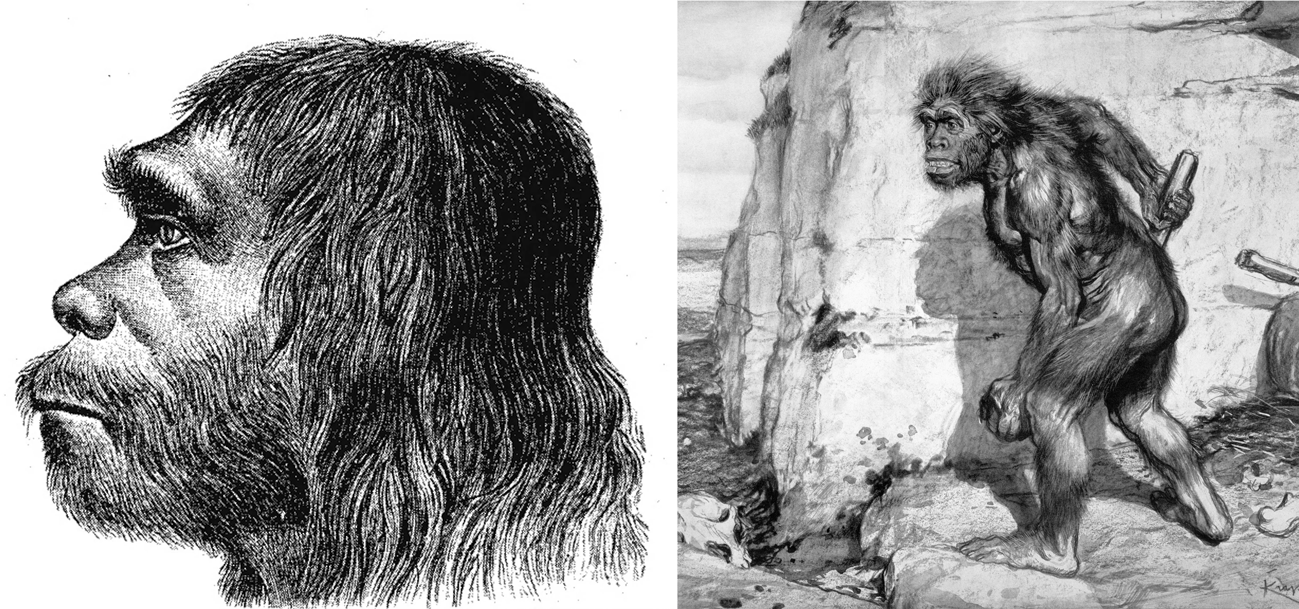
Interestingly, this was not the only way Neanderthals were imagined. Nearly two decades earlier, in 1870, Louis Figuier’s Primitive Man offered a very different vision. The book’s engravings by Emile-Antoine Bayard depict prehistoric humans as recognizably European figures: lean, long-haired, clothed in animal skins, but fundamentally human in posture and expression. Though later dismissed as romantic or anatomically imprecise, these images preserve a fundamentally human conception of the Neanderthal rather than the increasingly popular “missing link” model.
The decisive turn came with the discovery of the La Chapelle-aux-Saints skeleton in 1908. Interpreted by Marcellin Boule, the so-called “Old Man” became the foundation for a new canonical image: stooped, shambling, and unmistakably primitive.
Nearly half a century later, the hunched La Chapelle remains were revealed to be pathologically deformed, belonging to an individual who suffered from severe arthritis and degenerative joint disease. This revelation did little to disrupt the trajectory of Neanderthal depiction. The image had already taken hold.
From that point forward, even as anatomical corrections were made, Neanderthals would continue to be rendered as subtly “other”, uncanny, and not quite human. Boule’s “Old Man” emerged from misinterpretation and the zeal of early Darwinists who were determined to place Neanderthals below modern man on the progressive gradient of human evolution.
But even as Boule’s interpretation began to define the Neanderthal in both scientific and popular imagination, alternative visions persisted. In 1911, the British anatomist Arthur Keith published a reconstruction that sharply diverged from the emerging consensus. His depiction, titled “Not in the Gorilla Stage: the man of 500,000 years ago,” presents a recognizably human figure.
Keith’s reconstruction echoes earlier engravings from Louis Figuier’s work, depicting an upright, composed man, only subtly differentiated from a modern European. Both depart from the increasingly popular image of the Neanderthal as a stooped, simian intermediary, rendering him as a man of a different age rather than a different order.
Interestingly, while like Figuier’s, Keith’s interpretation would be cast off as romantic or uninformed, it is prescient: the Neanderthal is depicted as fashioning a tool and wearing jewelry, and even its title (the man from 500,000 years ago) places Neanderthals closer to modern timelines than his contemporaries were willing to consider. At that point, they certainly wouldn’t have granted Neanderthal man the capacity for aesthetic ornamentation.
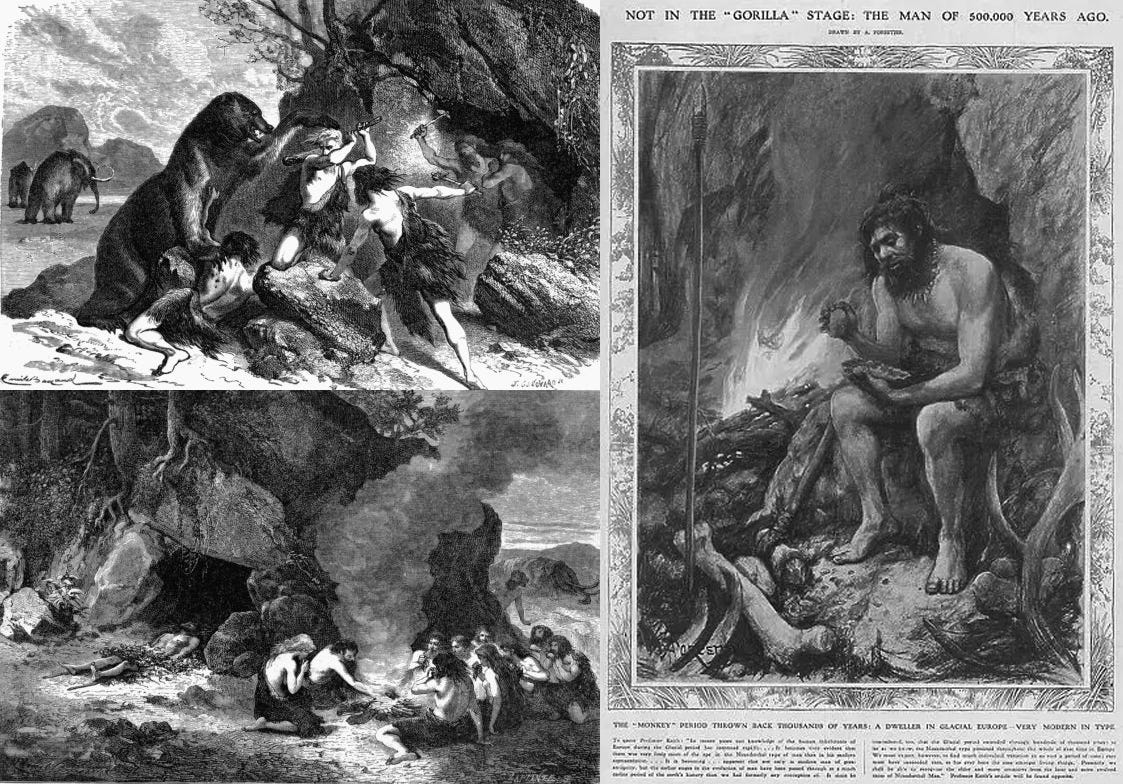
Even in this early period, more radical interpretations occasionally surfaced. At sites such as Drachenloch and later Le Regourdou, researchers, including Emil Bächler and Roger Constant, argued for what appeared to be structured deposits of cave bear remains arranged in ways that suggested something beyond subsistence. These interpretations, often framed as evidence of a “bear cult,” implied a level of religious behavior far deeper than the dominant image of the Neanderthal could accommodate.
Such claims were never fully integrated into the mainstream understanding. They remained a near-human species, rather than participants in the same human story. But their presence is notable: even at the margins of early research, some saw Neanderthals as being capable of symbolic ideation and religious behavior.
Postwar Progress
The postwar period marks the first meaningful rupture in the dominant brutish Neanderthal model. In the 1950s, excavations at Shanidar Cave in northern Iraq by Ralph Solecki uncovered remains that would complicate the prevailing image of the Neanderthal, extending beyond anatomy into behavior and character.
Analysis of individuals such as Shanidar 1 revealed a severely injured individual who survived for years with debilitating conditions, suggesting a social structure that could sustain the vulnerable. More striking still was Shanidar 4, whose burial contained concentrated clusters of pollen from multiple species of flowers. The arrangement points to the possibility of ritual or symbolism, or at least a sensitivity to the dead not previously granted to Neanderthals.
Solecki brought these findings to a wider audience with The First Flower People (1971), reframing Neanderthals in a way that resonated with the cultural climate of the time. Positioned against the backdrop of a generation seeking a return to nature, Neanderthals were reimagined as participants in a different mode of life, one grounded in communal living and spiritual expression.
While it did spark interest, it did not immediately translate into a new image. As Neanderthals entered popular consciousness through novels and films, their portrayal often oscillated between fascination and caricature. Writers like Jean Auel vividly animated prehistoric life, but retained the essential structure of the older stereotype: the Neanderthal as physically imposing, emotionally limited, and distinctly lesser than modern humanity. Even as science began to soften the image, culture preserved its outline.
By the late 20th century, a more substantial revision was underway. Researchers Erik Trinkaus and João Zilhão argued that Neanderthals engaged in ornamentation, pigment use, and ritual practices, placing them within the same cultural horizon as early modern humans. Their work on the Lapedo child reframed Neanderthals as culturally sophisticated beings with clear biological continuity to living populations—a controversial position that has since been vindicated.
But even with these developments, the shift was incomplete. Neanderthals were still widely characterized in a way that aligned with Marcellin Boule’s officially redacted 1908 interpretation. They remained a near-human species, rather than as participants in the same human story. The image was softening, but it had not yet dissolved.
Revelations
The most decisive shift in the understanding of Neanderthals came from DNA. In 2010, the publication of the Neanderthal genome confirmed that modern humans outside of Africa carry between 2–5% Neanderthal DNA, forcing a reconsideration of the distinction between “them” and “us,” long treated as categorical and now revealed to be permeable.
But this is raw data, not interpretation. Over fifteen years later, meaningful anthropological realignment has come less from the scientific mainstream than from a handful of persistent dissenters.
Before the paleogenomic breakthrough, some thinkers had already begun to explore its implications. Among them was Stan Gooch, who spent decades arguing that modern humans carry a deep inheritance from archaic populations. Writing in the 1970s, Gooch proposed that the human psyche reflects a hybrid origin, shaped by the merging of distinct populations with different cognitive and cultural orientations. He suggested that aspects of myth, religion, and symbolic thought could be traced to this inheritance, anticipating a continuity between Neanderthal culture and the modern mind long before it could be demonstrated biologically.
Gooch’s work remained marginal, but the year of his death—2010—coincided with the publication of the Neanderthal genome, which established interbreeding as a matter of fact rather than speculation. What had once appeared as an imaginative reconstruction now stood in partial alignment with empirical evidence.
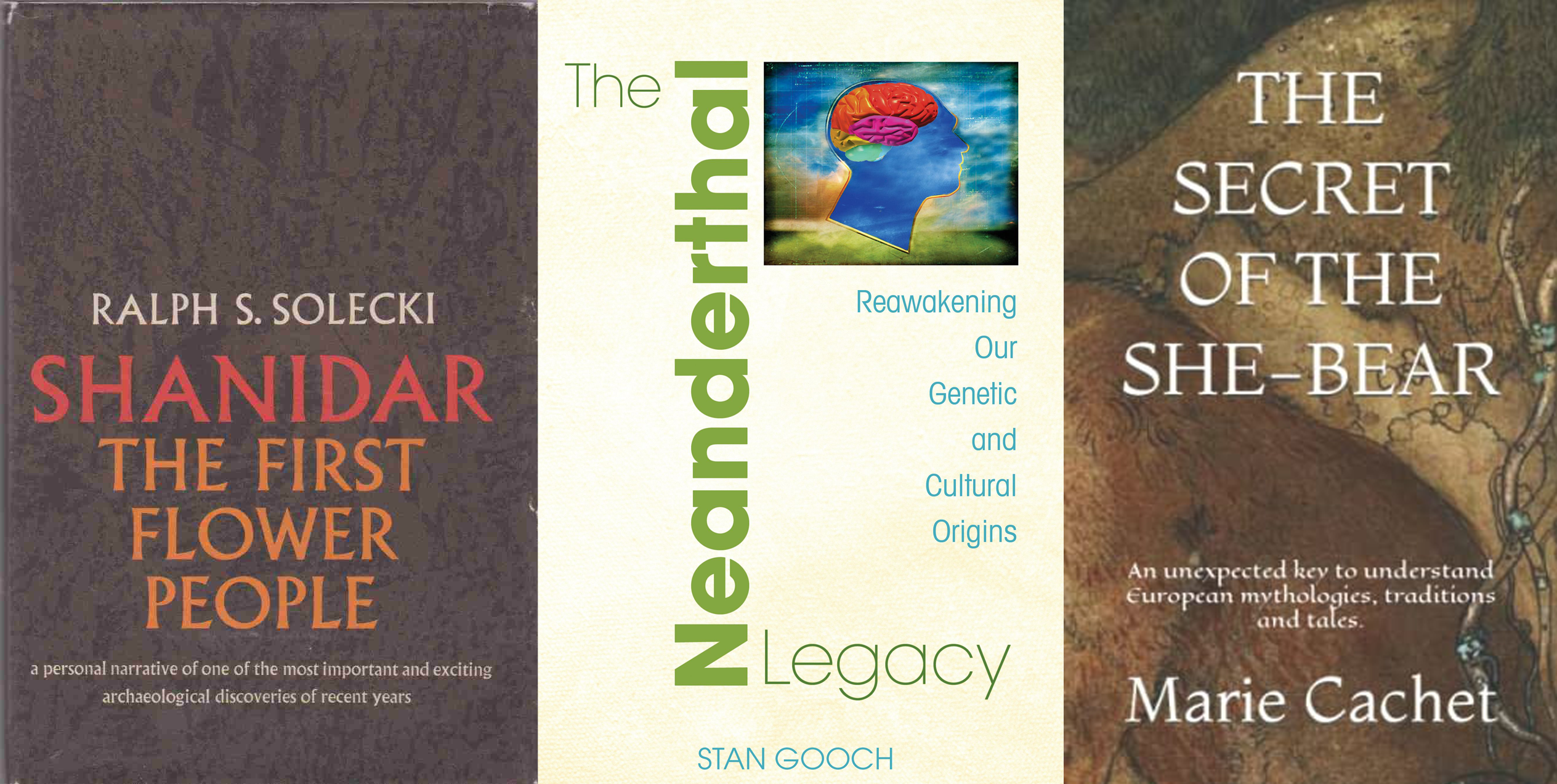
More recent figures have extended this line of thought in new directions. In the early 2010s, following the publication of the Neanderthal genome, researcher Marie Cachet began developing a series of genetic interpretations that challenged how Neanderthal inheritance was being presented. While often summarized as a small, relatively insignificant percentage of DNA, this figure obscures the presence of genetic segments of Neanderthal origin—persistent elements within the modern human genome contributing to distinct archaic traits.
In her later work, particularly The Secret of the She-Bear, she extends this perspective into the cultural domain, exploring the persistence of Neanderthal symbolism within the mythological traditions of Eurasia and drawing connections between prehistoric populations and recurring patterns of meaning, including the “bear cult” theory that had been ignored for a century.
Prominent geneticist David Reich has acknowledged the philosophical implications of this realization, noting—half seriously—that one could describe non-African populations as “Neanderthals with a modern human admixture,” a deliberately inverted framing that challenges conventional assumptions about identity and ancestry. The phrasing is provocative, but the underlying point is straightforward: what we call “modern human” already includes a measurable inheritance from archaic populations. In a recent interview, Reich goes further, describing elements of the traditional “standard model” as “hard to believe,” reflecting a broader shift away from earlier, more cleanly separated accounts of human origins.
At the same time, related ideas have emerged within the neurosciences. Patrick McNamara has suggested that Neanderthals may have played a foundational role in the development of shamanic or religious experience, proposing that key aspects of altered states of consciousness and symbolic cognition extend back into archaic human populations.
Taken together, these perspectives—spanning multiple disciplines—suggest a convergence that has yet to be fully articulated. The Neanderthal appears increasingly as a formative presence: a contributor to human biology, a participant in cultural inheritance, and a potential influence on the structures through which meaning is experienced.
The framework is not yet complete, but its outlines are already visible.

Works Cited & Further Reading
Donald Grayson, 1983 — The Establishment of Human Antiquity
Oxford Journal of Archaeology, 2000 (J.R.R. Drell) — Neanderthals: A History of Interpretation (Oxford Journal of Archaeology)
Proceedings of the American Philosophical Society, 1954 (Loren Eiseley) — The Reception of the First Missing Links
NIH, 2020 (Peeters, Zwart) — Neanderthals as familiar strangers and the human spark: How the ‘golden years’ of Neanderthal research reopen the question of human uniqueness
Louis Figuier, 1870 — Primitive Man
Ralph Solecki, 1971 — The First Flower People
Svante Pääbo, 2014 — Neanderthal Man: In Search of Lost Genomes
Stan Gooch, 2006-8 — The Dream Culture of the Neanderthals/The Neanderthal Legacy
Marie Cachet, 2012-17 — Atala/The Secret of the She-Bear
Loved tracing the logic of these interpretations! Crazy how recent so much of our understand is with DNA. Have you written about the bear-cult theories? I came across that reference researching a deity called Artio from the Iron Age- so curious what else we know about them.
Really digging your work. Thsnk you. In one of my fantasy settings many archaic hominids never became extinct or watered down. Your work is very helpful in yhe development of this.